


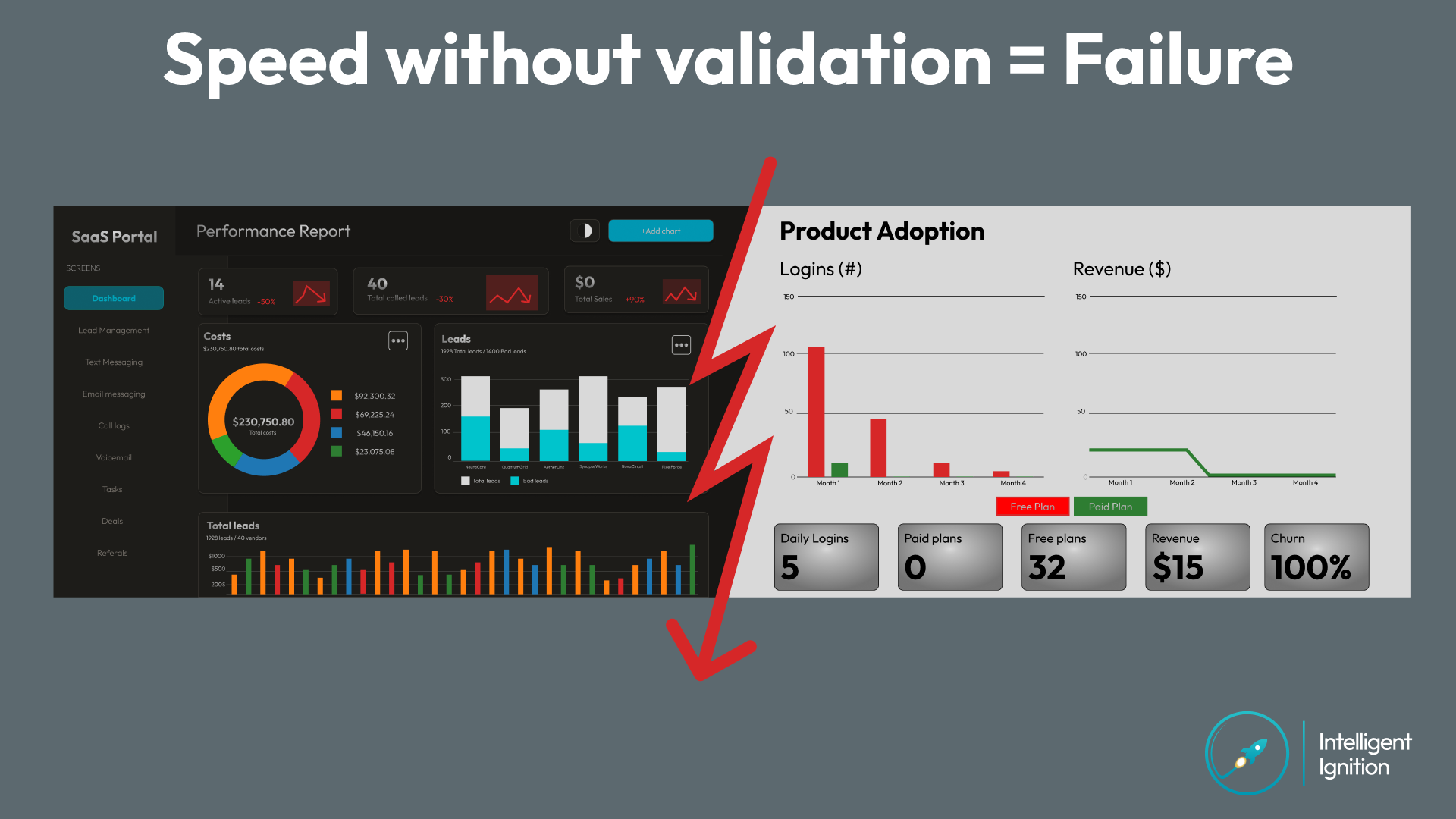
Picture this. It’s Tuesday at 11pm, a founder, let’s call him Marcus, has just deployed his new application. Twelve weeks of weekends and evenings. Maybe $400 in AI tool subscriptions and API costs. He used Cursor and Claude to build what would have taken a team of three developers eight months just two years ago. The UI is clean. The onboarding flow is tight. The landing page copy practically wrote itself.
He posts on X. Gets 400 likes. Forty people sign up for the waitlist.
Ninety days later, Marcus shuts the product down. Three paying customers. Two of them were friends.
Nobody told Marcus the idea was bad. In fact, everybody he talked to said it sounded great. The problem is Marcus never really talked to anybody. He talked at people — showed demos, pitched the concept, basked in the “I’d definitely use that” responses. What he never did was sit down with a stranger who had the actual problem and say: walk me through how you handle this today. Show me the pain.
Marcus isn’t unusual. Marcus is the story of 2025 and 2026 written thousands of times over.
The Friction Was the Filter
Here’s something nobody tells you about the old way of building: the pain of it was actually doing you a favor.
Before AI tools, an MVP cost real money — $50,000 to $150,000 in engineering time, minimum, and months of your life. That investment forced a kind of honest reckoning. If you were going to burn that kind of cash and time, you’d better be reasonably sure people would actually want the thing. You’d talk to customers. You’d write specs. You’d look for reasons not to build before you committed. The cost of building wrong was so high that validation wasn’t a methodology — it was survival instinct.
That instinct no longer fires. Because building got cheap.
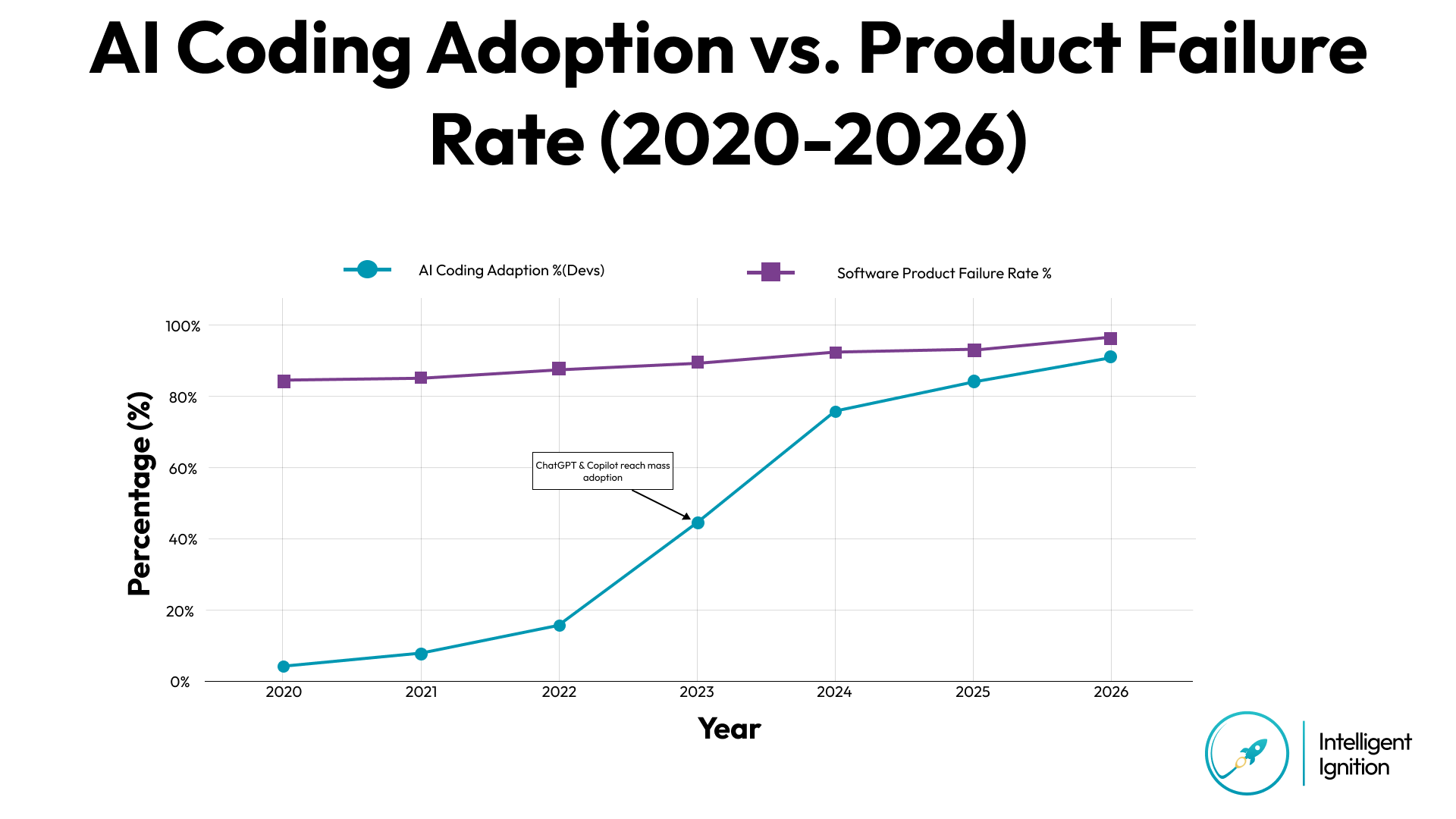
Now a solo founder can prompt their way to a functioning SaaS prototype in an afternoon. No team. No runway. No commitment beyond a few hours of flow state and a $20 subscription. By mid-2025, somewhere between 25% and 40% of all new startup code was AI-generated or heavily AI-assisted — and that number is still climbing[1].
At Y Combinator’s Winter 2025 batch, 21% of companies had codebases that were 91% or more written by AI[2].
The barrier to building has hit the floor. The barrier to building something people actually need hasn’t moved an inch.
Vibe Coding and the Feeling of Progress
There’s a name for the workflow that’s taken over: vibe coding. You describe what you want in plain English, watch the code appear in real time, hit deploy, and feel like a genius. It’s hit 92% adoption in indie developer and early founder communities[3]. That number is staggering. Nearly everyone building a new product right now is doing it this way.
And it feels like building. That’s the trap.
There is a specific dopamine hit that comes from watching your codebase grow. From seeing a live URL appear to showing a friend a working demo and watching their eyes go wide. It mimics the feeling of progress so perfectly that you can go weeks without noticing nothing is actually happening. No customer conversations. No real signal. Just features.
The entire MVP cost less than a night out. Which is precisely why nobody stopped to ask whether it should exist.


Here’s the cold math: a weekend prototype represents roughly 5% of what a commercial-grade product actually requires[4]. The other 95% — security, scalability, edge cases, compliance, documentation, support — is untouched. And 45% of AI-generated code carries security vulnerabilities straight out of the box[5]. Code complexity in AI-assisted teams has gone up 41%. Change failure rates have climbed 30%[6].
The speed is absolutely real. What’s also real is the debt accumulating underneath it.
The Same Old Lie, Running Faster
Here’s the thing that should keep every founder up at night: we were already terrible at validation before AI came along. AI just put the old problem on a treadmill.
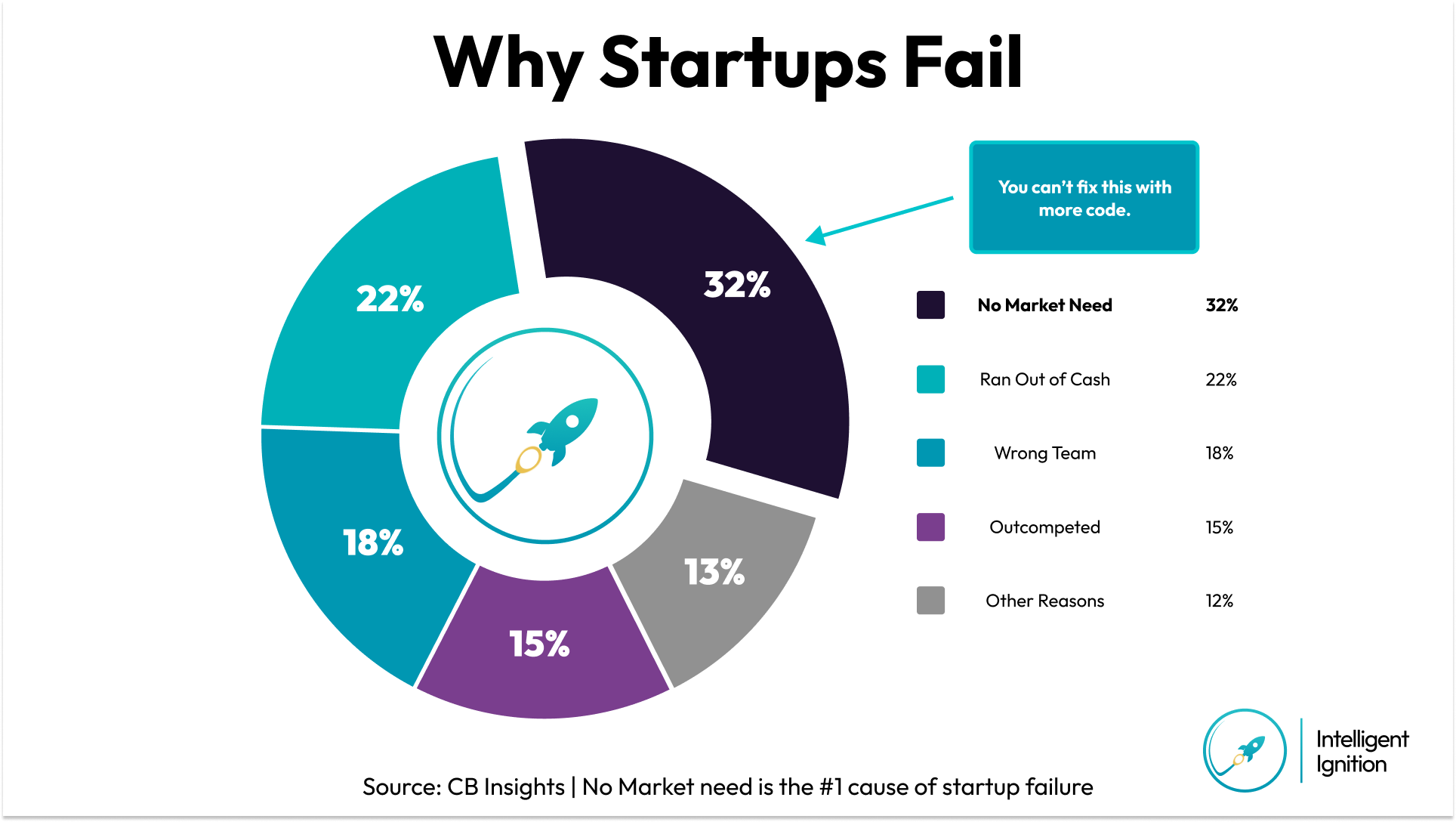
CB Insights has tracked startup failure causes for over a decade. Year after year, the same culprit sits at the top: 42% of startups fail because there was no real market need[7]. Not poor execution. Not bad timing. Not running out of money. Nobody wanted the thing.
And Harvard Business School research found that 67% of new products fail at launch even when some validation was done — because founders tend to ask questions designed to confirm what they already believe[8].
“Would you use a tool that solved X?” is not a customer interview. It’s a leading question dressed up as research. The human being across from you who likes you and doesn’t want to make things awkward says “yeah, absolutely.” You write that down as a data point. It is not a data point.
The real validation question is harder and less comfortable: “Tell me about the last time you dealt with this problem. What did you actually do? What did it cost you? What have you already tried?” That conversation takes courage to have because the answers might kill your idea. Most founders never have it. They build instead — and now they can build faster than ever before.
As one founder put it bluntly in a LinkedIn post that circulated widely in early 2026: “You’re gonna hate this and ignore it, but skipping validation doesn’t save time. It just moves the loss to a more expensive part of the timeline.”
The Wreckage Is Real and It’s Measurable
This is a financial crisis hiding in plain sight.
The U.S. alone loses $2.41 trillion every year to poor software quality — a figure that has grown consistently since CISQ began tracking it, driven by cybercrime, supply chain failures, and accumulating technical debt[9].
At the startup level, the picture is just as bleak. Founders typically estimate $5,000 to build an MVP. The real number is $47,000 or more[10]. And 92% of micro-SaaS companies die within three years regardless of how much they spent building[11]. The peak danger window isn’t at launch — it’s months 18 to 24, when initial funding runs dry, growth has stalled, and product-market fit still hasn’t materialized. Most founders don’t see it coming because early traction — a few hundred signups, some positive feedback, a handful of paying users — masks the deeper problem until the runway is nearly gone.
For funded SaaS companies that reach the $1M–$5M ARR range, capital efficiency tells the same story: early-stage companies typically spend $1.50 to $2.50 for every dollar of new ARR they bring in — a burn multiple that becomes fatal when the product lacks genuine market fit[12].
In Q1 2024 alone, 254 venture-backed startups shut down — the highest quarterly total in a decade[13]. And in the enterprise? MIT reported in 2025 that 95% of generative AI pilots at large companies are failing[14]. Not struggling. Not underperforming. Failing.
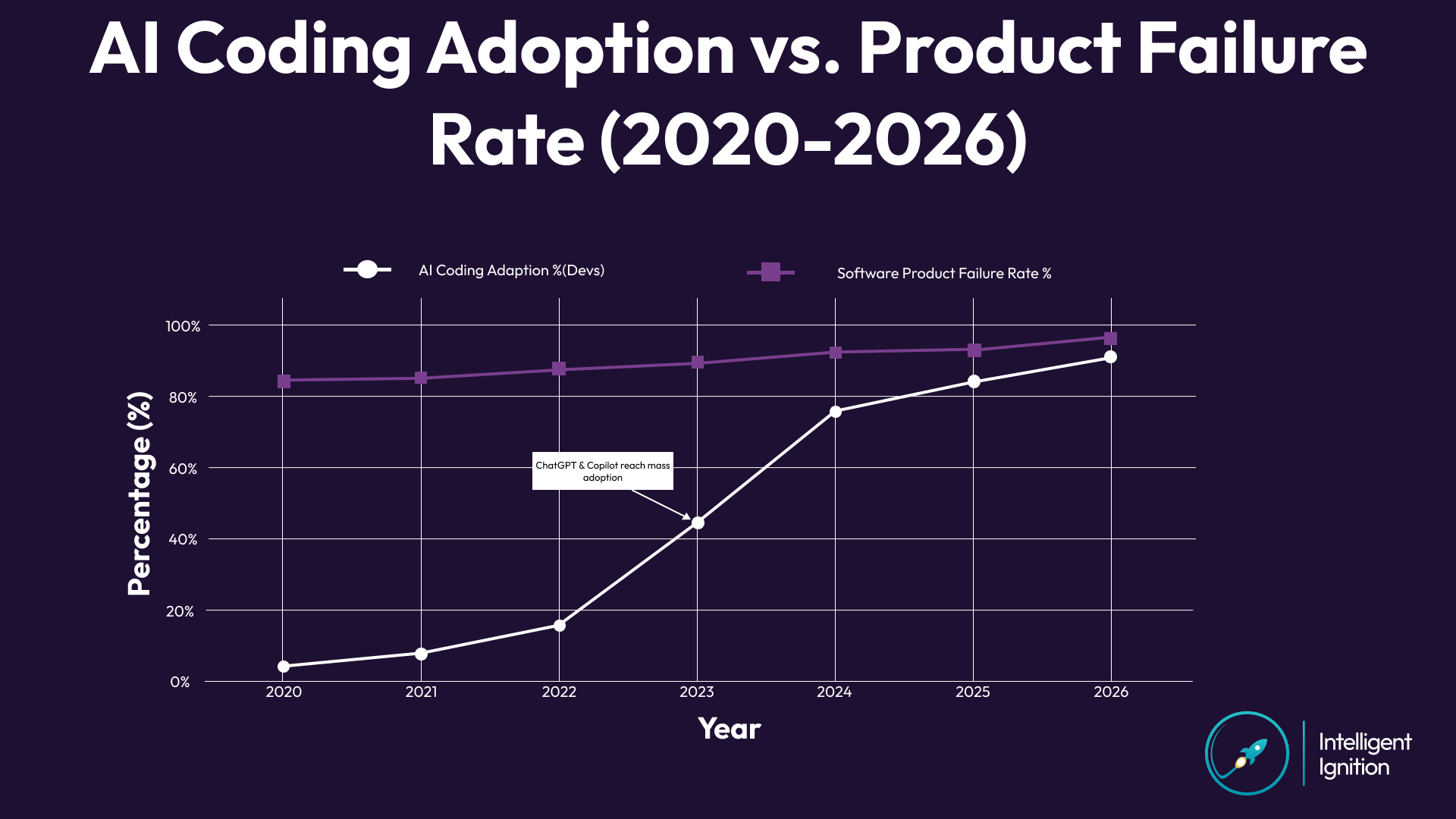
What makes the vibe coding era uniquely dangerous isn’t just the initial build — it’s the timing of the collapse. AI-generated codebases accumulate maintenance costs at 30–50% of original development cost annually, compared to 20–25% for traditionally written code[15]. That bill matures around month 18. So the founder who built fast arrives at the valley of death simultaneously managing three crises previous generations faced one at a time: no product-market fit, no runway, and a codebase too fragile to pivot with[16].
The spend breakdown for a typical failed startup tells the story clearly:
-
Engineering and development eats the largest share — the literal cost of building the wrong thing
-
Customer acquisition burns next — pushing people toward a product that doesn’t fit
-
Infrastructure scales unexpectedly once users start stress-testing it
-
Compliance and security debt eventually demands payment, always at the worst moment
-
Founder opportunity cost — 18 to 24 months of your life, not on any balance sheet, never recovered
The Maddening Part: AI Can Actually Fix This
Here is where it gets genuinely frustrating. The same category of tools being pointed at the wrong target could be aimed at the right one.
AI-powered customer discovery, competitive mapping, sentiment analysis, and demand validation can compress what used to take six to eight weeks of research and interviews into three to five days[17]. You can use AI to model your assumptions, steelman the reasons your idea will fail, identify which customer segment is most likely to churn, and surface competitors you haven’t heard of — all before writing a single line of code.
The SaaSpocalypse reshaping public markets right now — the $300 billion in software market value that evaporated in a single trading session in early 2026[18] — isn’t just about AI replacing SaaS products. It’s a market finally repricing products that were never as defensible as they looked. Products built on workflow convenience with no real data moat, no proprietary insight, no genuine customer lock-in. Products that were, at some level, always guesses.
The founder who validates thoroughly in two days and pivots twice will always beat the founder who ships a polished product in two weeks to silence. The technology to do that fast, rigorous validation exists right now. It’s the same technology most founders are using to skip it entirely.
What the Winners Are Actually Doing
The SaaS market in 2026 is the noisiest it has ever been. Every week hundreds of new tools ship from AI-assisted developers who somewhere along the way confused “building” with “validating.” The noise is deafening which means genuine signal — a product solving a specific, painful, well-understood problem for a clearly defined customer — is rarer and more valuable than it has ever been.
The competitive moat is no longer “I shipped first.” It’s I understand my customer better than anyone else. The founders who will win aren’t the fastest builders. They’re the ones who can’t stop talking to customers, who treat every conversation as intelligence, who use AI to accelerate their understanding of the market before they use it to accelerate their development velocity.
That means flipping the default sequence:
-
Talk to customers before opening the IDE. Real customers. Strangers. People with no reason to be kind.
-
Build a landing page before building the product. Test the message. Measure the click. Count the signups.
-
Pre-sell before you pre-launch. If someone won’t hand over a credit card number or a letter of intent, “I’d use that” means nothing.
-
Use AI to stress-test your assumptions first. Ask it what would have to be true for your idea to fail. Ask it who your real competitors are. Ask it who shouldn’t be your customer. Then build.


J.P. Morgan put it clearly in a guide for founders navigating the vibe coding era: the goal should be to know whether something is working within one year[19]. Which means the rigor of validation has to increase proportionally with the speed of building — not disappear because building got easier.
One Question
The tool didn’t kill your product. The sequence did.
AI handed founders the ability to skip from “I have an idea” directly to “I have a live product” without passing through the territory that actually determines outcomes. Does anyone need this? Will they pay for it? Can you reach them at a cost that makes sense? That’s the territory. Every founder who skips it isn’t moving faster. They’re just arriving at failure with better code, a nicer UI, and less runway to try again.
The API credits were the cheapest part. The 18 months were not.
The best time to use AI is after you’ve validated the problem. Before that, it is the most sophisticated and beautifully disguised form of procrastination ever invented.
So before you open your next project. Before you spin up a repo, pick a stack, choose a color palette, or argue about a name — answer this honestly:
""When did you last have a real conversation with a customer who had no reason to tell you anything but the truth?
If the answer is “not yet,” the most valuable thing AI can do for your product today has nothing to do with code.
At Intelligent Ignition, we work with early-stage founders to structure the validation work that determines whether building is even the right next step — before a single sprint is planned. If you’re about to start building something new, come talk to us first.
References
-
State of Developer Ecosystem. (2025). JetBrains Developer Survey 2025.
-
RockingWeb. (2025). The True Cost of Building an MVP in 2025.
-
Pixelmojo. (2026). Vibe Coding and Technical Debt: What the 2026 Data Shows.
-
GitClear. (2024). Coding on Copilot: 2023 Data Suggests Downward Pressure on Code Quality.
-
RockingWeb. (2025). The True Cost of Building an MVP in 2025.
-
MIT Sloan Management Review. (2025). Why 95% of Generative AI Pilots Are Failing.
-
BayTech Consulting. (2026). AI Technical Debt: How Vibe Coding Increases TCO.
-
Pixelmojo. (2026). Vibe Coding and Technical Debt: What the 2026 Data Shows.
-
siift.ai. (2026). 7 Best AI Tools for Founders 2026: Build Smarter Startups.
-
Forbes. (2026). $300 Billion Evaporated: The SaaSpocalypse Has Begun.
-
J.P. Morgan. (2025). Founder’s Guide to Navigating the Vibe Coding Era.
Comments