



You know that high you get from your first paying customers?
The Stripe email hits. Someone you’ve never met just paid real money for something you made. You screenshot it. You send it to your co-founder. You start casually dropping the phrase “our customers” into conversations.
This is the moment where a lot of good founders quietly doom their companies.
Not because revenue is bad. Not because early adopters are bad. But because those first 5–10 customers are almost never telling you what you think they’re telling you.
They’re not proof of product-market fit. They’re proof that you can convince a small number of people, usually people who are biased toward wanting you to succeed, to take a chance on you.
That’s it.
The Politeness Problem
There’s an uncomfortable truth at the heart of early stage validation. Your customers are lying to you.
Not because they’re malicious but because they are human.
- Your friends don’t want to hurt your feelings.
- Your network wants to be supportive.
- Early adopters like being first — they’re biased toward yes.
- Warm intros come with social pressure baked in.
So when you ask, “What do you think of this?”, you’re not gathering objective feedback. You’re running a popularity test for how much someone likes you.
CB Insights has been collecting startup post-mortems for a decade. Across thousands of failures, the single most common cause is still the same: poor product-market fit, or “no real market need,” shows up in about 43% of cases.[1][2] Meanwhile, founders in those same post-mortems describe how excited people seemed early on. How their first customers were “obsessed.” How their beta users “loved the product.”
If excitement and compliments reliably predicted success, that 43% number wouldn’t exist.
The politeness problem is so common that Rob Fitzpatrick wrote an entire book about it, The Mom Test. His core point is brutal and freeing at the same time: if you ask bad questions, your own mother will lie to you. Not because she’s a liar — because she loves you.[3][4]
Your first 10 customers are doing the same thing. They’re not lying about facts. They’re lying with their silence, their softness, and their “yeah, this is cool” instead of “this makes my life meaningfully better in a way I would pay for again.”
Early Traction Is the Noisiest Signal You’ll Ever Get
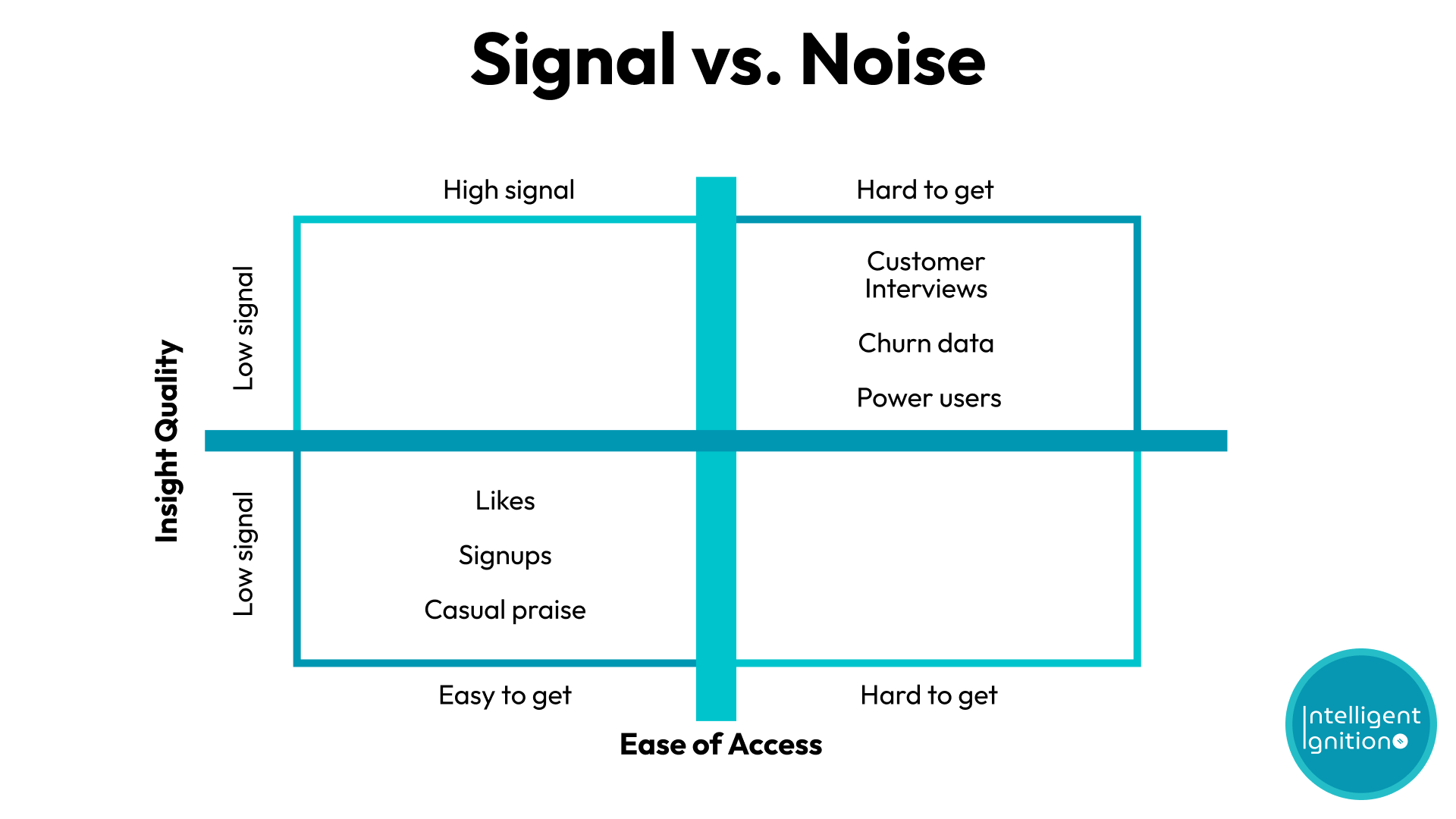
Here’s the trap: the numbers look great at the beginning.
- 200 people on the waitlist
- 30 onboarded
- 10 start paying
- 1 or 2 are super active and send you long feedback messages
If you’ve never done this before, that can feel like liftoff. “We have customers. We have revenue. We’re off the ground.”
RockingWeb’s 2025 analysis of 1,000+ micro-SaaS businesses shows a different picture. The vast majority, 92%, will be dead within three years. Almost half of those failures happen in the “valley of death” between months 18 and 24, when the easy wins are exhausted and the cold market quietly shrugs.[5][6]
The same dataset gives a rough survival checklist:
- Months 1–6: 100+ customer interviews, first few paying customers, basic unit economics emerging
- Months 7–12: $1K+ MRR, churn <5%, one acquisition channel that actually works
- Months 13–18: $5K+ MRR or a clear path to profitability, LTV:CAC >3:1, usage steadily growing[5]
Most founders who die at month 18 report something like: “We had early customers. We just couldn’t grow beyond them.”
That’s the real danger of early traction: it looks like a trend when it’s often just a pocket.
You haven’t proven you have a market. You’ve proven you have:
- A network
- Some persuasion skills
- A handful of people willing to experiment
Those are good things. They are not THE thing.
Opinion vs. Behavior: The Only Line That Matters
The validation methods most founders use would make any behavioral scientist wince.
- “Would you use this?”
- “Does this sound useful?”
- “If I built X, would you pay for it?”
- “Would your team find this helpful?”
Harvard Business School research puts a hard number on how bad this is: roughly 67% of products fail at launch even when they had “strong” market validation beforehand.[7] In other words, customers said yes during research — and then said no with their wallets.
Why? Because opinions about the future are cheap. Behavior in the past is real.
This is the whole heart of The Mom Test in one sentence:
Stop asking what people would do. Start asking what they did do.[3][8]
| Bad Question | Good Question |
|---|---|
| “Would you pay for a tool that automates your reporting?” | “Walk me through the last time you did your reporting. How long did it take? What tools did you use? What was the most painful part?” |
| “How much would you pay for something like this?” | “What have you already tried to solve this? How much did you spend? Why did you stop using it?” |
| “Does this sound useful to your team?” | “Tell me about the last time this problem came up. What did your team actually do?” |
Table 1: Opinion vs. Behavioral Questions
When you ask about the past people can’t lie without effort. They have to tell you what actually happened. Fitzpatrick’s research and the broader Mom Test community have seen that switching from opinion questions to behavioral questions reduces “false positive” validation by more than half.[9][8]
Your first 10 customers are invaluable — if you treat them as a source of behavioral data, not as a jury delivering a verdict on your genius.
The Three Early Customers You Really Need
Most founders over-index on one type of early customer: the enthusiastic power user who loves everything they build.
You actually need three:
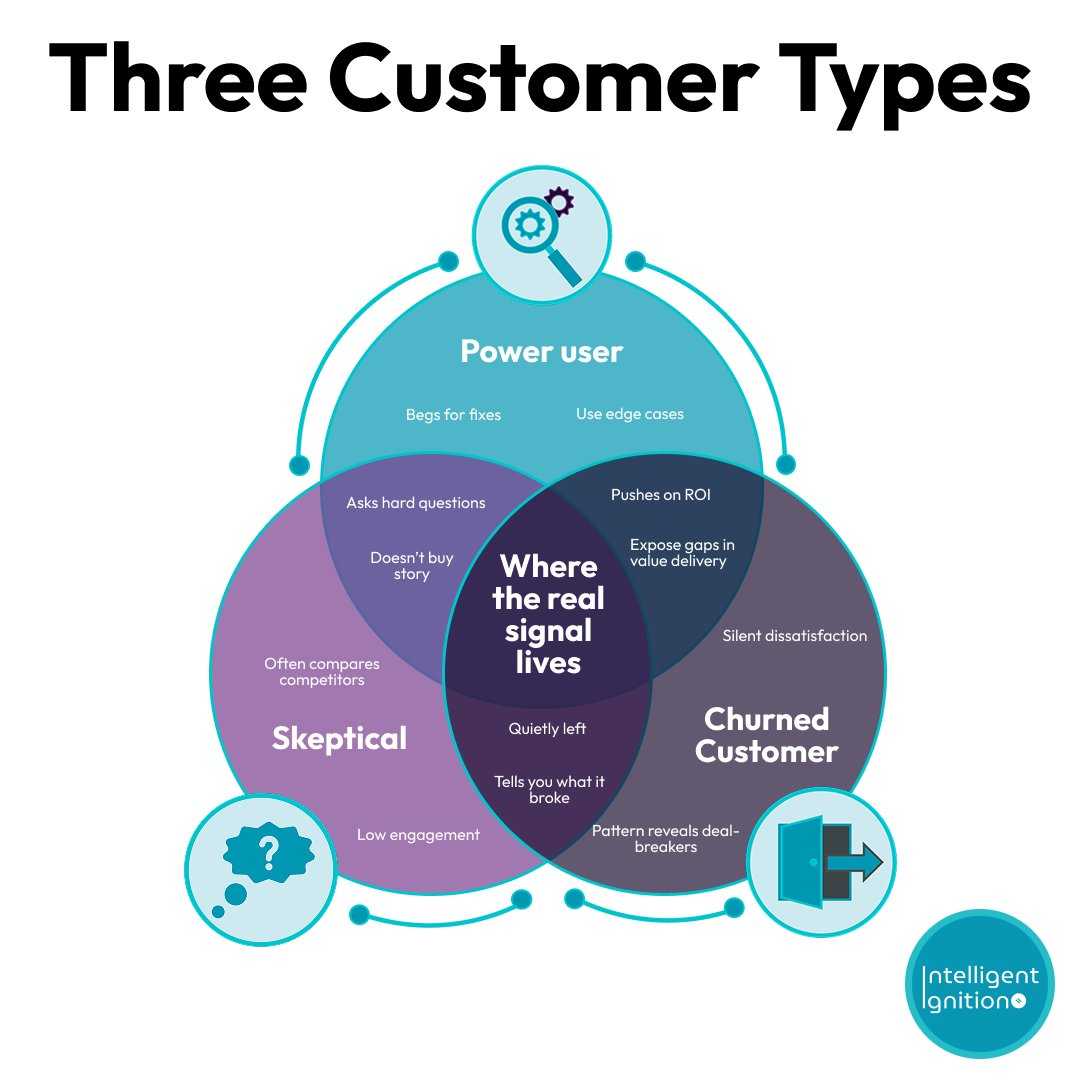
1. The Power User (Stays and Shouts)
- Uses the product often
- Pushes it into new use cases
- Sends long feedback messages unprompted
- Goldmine for depth: “What made this worth your time? What were you doing before this existed?”
2. The Skeptic (Stays but Complains)
- Uses the product, but reluctantly
- Regularly tells you what’s broken or annoying
- Constantly compares you to alternatives
- Goldmine for differentiation: “What keeps you here despite the problems?”
3. The Churned Customer (Leaves Quietly)
- Signed up, maybe paid once, then disappeared
- Often doesn’t answer follow-ups unless you’re humble and specific
- Goldmine for truth: “What were you hoping this would do that it didn’t?”
If your first 10 customers are all power users, all warm intros, all cheerleaders — you don’t have a product, you have a fan club.
You need at least one of each:
- The power user tells you what to double down on.
- The skeptic tells you where to shore up your moat.
- The churned user tells you whether there was ever a moat in the first place.
Most founders avoid two and three because those conversations are uncomfortable. That’s exactly why those conversations are where the real information lives.
How to Talk to Your First 10 Customers Without Getting Lied To
Here’s a simple way to have early conversations that don’t turn into polite fiction.
Rule 1: Talk about their life, not your idea
Start with, “Tell me about how you handle X today.” Stay there — don’t pitch, and don’t show the product for at least 15–20 minutes.
Rule 2: Ask about specific recent events
“Walk me through the last time.” “What did you do before that?” “What happened after?” Specifics kill fantasies.
Rule 3: Hunt for pain and workarounds
Anytime you hear “it’s fine,” start digging. “If you had a magic wand, what would you change?” Look for spreadsheets, duct-taped tools, and manual tasks people complain about but keep doing.
Rule 4: Look for commitment, not compliments
End with something that requires a tiny bit of sacrifice:
- “Can I put 30 minutes on your calendar next week to show you a prototype?”
- “If we built this, would you be willing to introduce me to two colleagues who struggle with the same thing?”
- “Would you prepay for three months to get early access and shape the roadmap?”
If they won’t give you their time, reputation, or money in even a small way now, they probably won’t give you more in the future.
This is how you turn your first 10 customers from a confidence trap into a learning engine.
What Real Early Validation Actually Looks Like
Founders look for the wrong milestones early on:
- “We have 500 people on the waitlist.”
- “We have 20 paying customers.”
- “We hit $1K MRR.”
None of those are bad. They’re just incomplete.
Here’s what healthy early validation tends to look like in the wild:
- At least 20–30 real conversations where you talked 20% and listened 80% of the time, and you heard the same problem description enough times to finish people’s sentences.
- A small group of customers (even 3–5) who use the product weekly without you reminding them, complain when you break something, and refer someone unprompted or talk about you in their own channels.
- Some form of real commitment: Prepaid pilots, LOIs (even non-binding) from companies who want to roll out if you hit X, or customers who pay you before the product feels “done.”
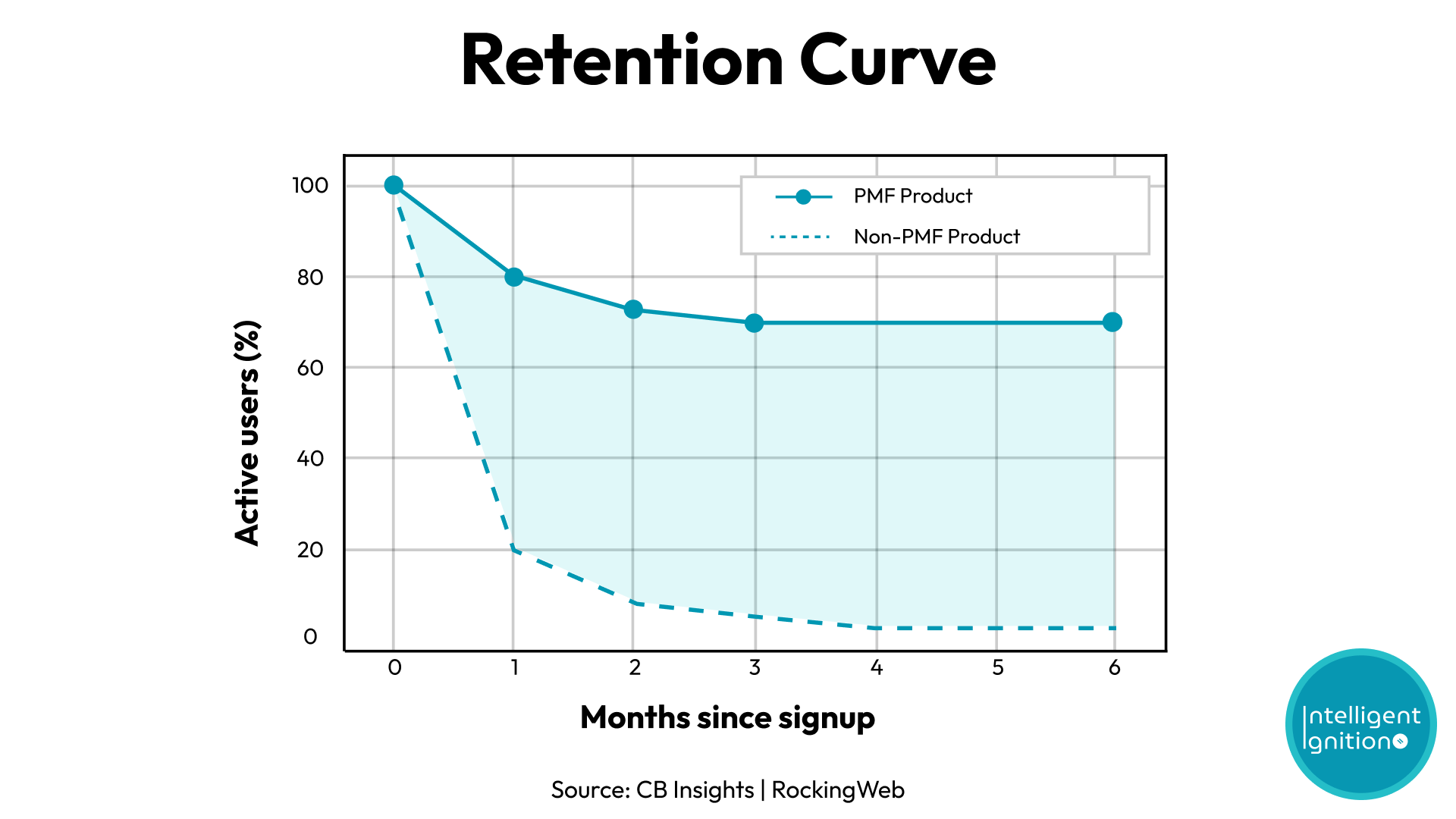
Preuve AI’s 2024–2025 analysis of 3,000+ startup ideas found that only about 11% of concepts scored high enough on behavioral validation metrics to justify building — even though almost all of them looked exciting on paper and in pitch decks.[2] The gap between “sounds good” and “people actually change behavior and pay” is huge.
Your job in the first 10 customers phase is not to prove that you have a business. It’s to find out as fast as possible whether you don’t.
The Real Job of Your First 10 Customers
Your early customers are not:
- A finish line
- A marketing asset to brag about on LinkedIn
- Evidence that you should double the dev budget
They are:
- A focus group that actually uses the thing
- A mirror reflecting your assumptions back at you
- A cheap way to discover if you’re wrong while you still have time to change
The most dangerous sentence you can say after landing early customers is, “It’s working.”
A better sentence sounds like this: “We have just enough signal to ask smarter questions.”
Because here’s the uncomfortable pattern hiding in all the data:
- Most founders don’t fail because nobody ever cared about their idea.
- They fail because the wrong people cared, a little bit, at the beginning — and that was enough to keep them building long after they should have gone back to listening.
Your first 10 customers aren’t lying because they’re bad people. They’re lying because you’re asking them the wrong things and listening for the wrong answers.
Change the questions. Change what you count as proof. And suddenly those same 10 customers become the reason you don’t burn 18 months and $47,000 building the wrong thing perfectly.
What to Do Next
If you’re in the early customer phase right now and the validation feels fuzzy — or if you’re about to launch and want to make sure you’re asking the right questions before you scale — we can help.
At Intelligent Ignition, we structure customer discovery and validation work before a single sprint is planned. Our Spark Plan is designed for exactly this stage: you get weekly check-ins, interview frameworks, customer synthesis, and clear go/no-go criteria — so your first 10 customers become your most valuable learning asset, not a vanity metric.

Book a free 30-minute discovery call: intelligentignition.com/contact
Or download our 10 Customer Interview Questions That Actually Work guide — a structured interview script with real examples and follow-up prompts based on The Mom Test framework.

References
- CB Insights. (2026). Why Startups Fail: Top 9 Reasons.
- Preuve AI. (2026, March 16). Why 42% of Startups Fail (And What the Other 58% Get Wrong Too).
- Durmonski, I. (2025, December 22). The Mom Test by Rob Fitzpatrick [Actionable Summary].
- LessWrong. (2024, April 17). The Mom Test: Summary and Thoughts.
- RockingWeb. (2025, January 25). 92% of Micro SaaS Fail Within 18 Months [2025 Survival Data].
- RockingWeb. (2025, February 26). 1,000 Micro SaaS Analysed: Real Revenue Data [2025 Study].
- Christensen, C. M., Hall, T., Dillon, K., & Duncan, D. S. (2016). Know Your Customers’ ‘Jobs to Be Done.’ Harvard Business Review.
- Female Switch. (2026, February 25). Mom Test Customer Interviews For First Time Entrepreneurs.
- PopWave. (2026, February 11). Avoid Biased Feedback: Master The Mom Test for Startups.
Comments